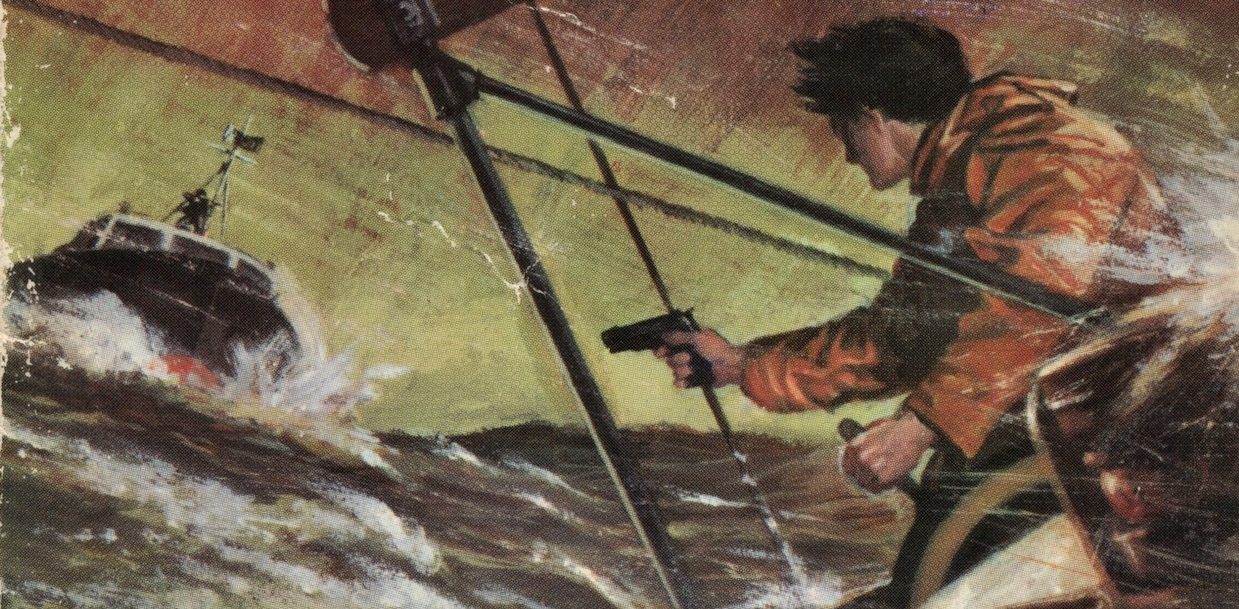

I first came across this intriguing, undated, screenplay of Running Blind almost nine years ago in 2017 whilst researching Bagley’s archives at the Howard Gotlieb Archival Research Center in Boston USA. Written by Sol Reybvinnar for the London based Hemisphere Productions, it had been listed by the archivist as ‘possibly an early draft of the BBC film script as it seems to follow the BBC production line’.

In February 2024 I managed to acquire a copy of the screenplay myself from Baltimore based Royal Books, who specialise in rare books and paper relating to twentieth century literature, genre fiction, the arts, and popular culture, with a particular emphasis on cinema. On closer inspection the screenplay actually follows Bagley’s novel, not the BBC production line. Furthermore, Jack Gerson was commissioned to write the screenplay for the BBC who held the film and television rights from 9 May 1977 until they were released on 4 February 1986.1 2
This screenplay seemed to fall between the period of 1974 when the film option on Running Blind that Geoff Reeve Productions Ltd., (with a screenplay written by Ian Rodger) lapsed, and before 9 May 1977 when Bagley gave the go-ahead for BBC Scotland to acquire the rights.3 However, oddly, there appeared to be no film options agreement connected with the Hemisphere screenplay filed in Bagley’s papers.
Neither Rodger’s nor Gerson’s screenplays are archived with Bagley’s papers, indeed neither is Bagley’s own screenplay written during his frustrating trip to Hollywood commencing on 18 November 1970. Of his own screenplay Bagley wrote:
It was the first script I’ve written and I don’t go a bundle on it – best to keep it hidden, in my opinion.4
All of these screenplays currently remain hidden, destroyed, or filed in other archives yet to be discovered, with no trace of any in Bagley’s archived papers in Boston. What follows is an account of the only screenplay for Running Blind filed with Bagley’s papers, Hemisphere Productions that produced it and the enigmatic Sol Reybvinnar who wrote it.
Whilst researching, I found an erroneous record of this screenplay (not the Royal Books listing) on WorthPoint, listing it as a 1973 screenplay of The Mackintosh Man, written by Sol Reybvinnar under the working title of Running Blind. Quite how this erroneous listing came about is perplexing, the person listing perhaps having little knowledge of either storyline.5 Walter Hill had written the screenplay for The Mackintosh Man, and more can be read about filming of Bagley’s novel The Freedom Trap here.
When I initially found the screenplay in Boston, I thought it could possibly be connected with Bagley’s Hollywood visit in 1970. Upon reading however, it became clear that this was not of Bagley’s hand. Sol Reybvinnar, although using English spelling writes with a distinctly American influence, and Bagley’s trademark attention to detail is clearly missing. There’s a somewhat irksome renaming, or misnaming, of Elín Ragnarsdóttir as Elin Ragmansdottir, an air stewardess meeting Alan Stewart for the first time on his flight to Iceland for Slade’s package collection and delivery. The screenplay includes flashback daydream sequences, one of which finds Stewart in a rest home following the death of Jimmy Birkby:

Wanting to find out more about the enigmatic Sol Reybvinnar, and realising there was a dearth of information about this mysterious individual, research into the production company seemed logical.
Hemisphere Productions is listed on the screenplay as being based at 105 Mount Street, London W.1. This address in Mayfair had in fact previously been the location of Winston Churchill’s batchelor flat, where he lived in 1904 when he crossed the floor of the House of Commons from the Conservative to the Liberal benches. In the 1970s the address was home to Hemisphere Productions run by independent film producer Barry Michael Levinson. Levinson was born in New York on 2 June 1932 and is not to be confused with the Academy Award winning American film director Barry Lee Levinson, who was born in Baltimore, Maryland on 6 April 1942.
Levinson, through Hemisphere, produced the 1972 film The Amazing Mr Blunden, adapted from Antonia Barber’s novel The Ghosts. The film was written and directed by the actor Lionel Jeffries and starred Laurence Naismith as the eponymous Mr Blunden. It is a children’s classic, fondly remembered and later remade as a television film, written and directed by the multi-talented Mark Gatiss.

In 1973 Levinson teamed up with executive producer Patrick Dromgoole, and associate producer Mike Towers from HTV (originally Harlech Television) in a joint Hemisphere/HTV production for ITV. The 90-minute television film Catholics, also known as Catholics – A Fable, Catholics – A Fable of the Future, The Catholics, Conflict, The Conflict and The Visitor, was adapted by Brian Moore from his 1972 novel. It is the story of an abbot who finds himself the reluctant figurehead of a doctrinal conflict with the Vatican. The production was directed by Jack Gold, and starred Trevor Howard, both of whom Levinson would work with again in his next project Who? Other leading roles were played by Martin Sheen, Cyril Cusack and Andrew Kier. Trevor Howard, who had then starred in forty major films, said at the London preview of Catholics that this was possibly the finest he had done.7

Catholics was televised in the US on 29 November 1973, with ABC, CBS and NBC being recipients of a Peabody Award that year for ‘outstanding contributions to entertainment through an exceptional year of televised drama’, the award mentioning CBS’s airing of the drama. The following year, on Easter Sunday, 1974, Catholics was shown in the UK.
What then followed were Levinson’s foray into espionage thrillers, the timeline for which I suspected the Running Blind screenplay belonged in.
Who? was a 1974 film from Lion International and Hemisphere Productions, directed by Jack Gold with music by John Cameron, and starring Elliot Gould, Trevor Howard and Joseph Bova. It was a joint production between Levinson and co-producer Kurt Berthold and was later titled Roboman and, in Australia, Prisoner of the Skull. The screenplay was written by John Gould, based on the 1959 science fiction novel Who? by Lithuanian/American Science Fiction writer Algirdas Jonas ‘Algis’ Budrys. The story concerns an enigmatic individual with a metal face who is returned from East Germany claiming to be Lucas Martino, an American scientist who was working on a top-secret project but was severely injured and scarred in a car crash. American authorities hold him in custody as they try to establish whether the man is the real Martino or an impostor looking for secret information about the ultimate rocket project developed in the West.


Ohio based JTC Video Inc., or indeed H H and Associates (the package designers), made somewhat of an error in their circa 1991 video distribution of Roboman by erroneously attributing the film’s Producer to the wrong Barry Levinson, Director of Bugsy and Rain Man.
Additionally, they changed the story’s synopsis—perhaps attempting to cash in on the success of The Terminator franchise, as 1991 saw the release of Terminator 2: Judgement Day—by describing the character Lucas Mantino as, ‘A Deadly Human Terminator! A monstrous Roboman, half-man, half-machine designed for massive world destruction.’ I imagine both Barry Levinsons, and perhaps even James Cameron, heaved a weary sigh of incredulity.
The Internecine Project, also released in 1974, was a further Lion International and Hemisphere Production, directed by Ken Hughes with music by Roy Budd and starring James Coburn, Lee Grant, Harry Andrews and Ian Hendry. Andrews had previously appeared as Edgar Mackintosh in the 1973 adaptation of Bagley’s novel The Freedom Trap filmed as The Mackintosh Man. The Internecine Project was produced by Barry Levinson for MacLean & Co., with co-producer Andrew Donally. The screenplay, by Levinson and Jonathan Lynn, was written under the working title Internecine, the title of the original novel by Mort W. Elkind. It is the story of former spy Robert Elliot who has recently been promoted to a government advisory position. In order to start his new job without any ties to his shady past, he crafts a scheme which will take out his four former associates over the course of one fateful night.
In her memoirs I Said Yes to Everything, leading lady actor Lee Grant comments of the film:
I had a really flimsy film to do in London, The Internecine Project. The script was no more than a sixteen-page outline, but the money was good and my co-star was James Coburn, an actor I admired and wanted to play with.6

The connection with Alistair MacLean’s ‘MacLean & Co.’, which featured in my previous article about a failed production of Running Blind by Geoffrey J. Reeve, is an interesting one as Reeve was also connected to MacLean & Co. There does therefore exist an obscure possibility, as there are no film options agreements filed in Bagley’s papers specifically relating to the Hemisphere screenplay, that it may have some connection to Reeve’s production, prior to Ian Rodger being commissioned to write the screenplay.
In July 1976 it was reported that Levinson had revealed plans for a $10-million program of five-British-based movies from his Hemisphere Productions over the next 18 months. Also, that British producer Aida Young had joined the board of Levinson’s company, and that she would be producing the first movie for him, Youth, Age and a Frog Prince, based on three John Collier short stories.7
The Hemisphere Production related to Youth, Age and a Frog Prince was in fact called Michael the First, the script a commissioned work of three short plays adapted from a story entitled A Youth from Vienna, one of which, Youth, was written by Jack Rosenthal, who whilst writing it ‘had no idea of the identity of the other writers’, who were Keith Waterhouse & Willis Hall and Tom Stoppard. It was the story of Michael, a medical student, romantically obsessed with the idea of finding the perfect girl for him. It was three-months earlier, on 7 April, 1976 that Aida Young had written to Jack Rosenthal suggesting he might like to adapt it for a feature film project. The project never came to fruition and the surviving draft, dated around 1976, is currently preserved as part of the Jack Rosenthal Drama Scripts Collection at the University of Sheffield.8

In 1979 an advertisement appeared in The Stage urgently requiring ‘young (16-18 years) Beautiful Girls to play Cinderella-type princesses in a forthcoming television series of folk-stories’.9 This was to become the series Storybook International, another Hemisphere and HTV joint production, which enjoyed much popularity, and is somewhat cherished. The weekly, half-hour series was a collection of folk tales and fairy stories from all over the world. The stories, adapted by Veronica Kruger, were published the same year by Victor Gollancz Ltd., accompanied by line drawings by Patricia Drew.
The series, which was first broadcast on ITV, 31 July 1981, consisted of 65 episodes, aired as three seasons, and although its distribution was originally confined to Britain and Europe, it enjoyed extensive cable play in the US, Scandinavia and the Middle East in subsequent decades. In 1984 the series was released as Stories and Fables under Walt Disney Home Video and it was released on VHS throughout the 1980s and 1990, the full series finally being made available on DVD in 2006.
The distinctive opening credits famously began with an animated title sequence, a troubadour singing the theme song, The Storyteller, accompanied by a friendly fox. The theme song was composed by Larry Grossman, with the lyrics being written by Barry Levinson. It’s an enjoyable composition to listen to, in the traditional English folk style, with Levinson’s lyrics and Grossman’s melody evoking nostalgia for those that remember the series.

In 1985 Levinson and Hemisphere were involved in another joint production with HTV, this time co-produced by Sebastian Robinson from HTV and directed by Alan Bridges. The one-hour television drama was called D.P. (Displaced Person) and was based on a short story by Kurt Vonnegut, it was adapted by Fred Barron and filmed in the West Country in spring 1985. Starring Rosemary Leach and Julius Gordon it told the story of ‘a young black orphan boy in Germany during the country’s occupation by allied troops. Running away from an orphanage, and the nuns who care for him, he meets his first black man, an American Sergeant, and thinks he must be his father’.10 Screened on the coast-to-coast PBS American Playhouse network in 1985, it won critical acclaim and an Emmy Award from the American Academy of Television Arts and Sciences. It was shown on the ITV network in the UK on 14 June, 1987.11
Barry Levinson passed away at The London Clinic, 20 Devonshire Place, Westminster on 23 October 1987, leaving a widow, Janet. His death certificate recorded their home address in Bal Harbour, Florida.12 Although nothing came of Hemisphere’s Running Blind project, Levinson did leave us with some notable productions, not least the critically acclaimed Catholics and Displaced Person, but also the cherished Storybook International and The Amazing Mr Blunden.
And what of the enigmatic Running Blind screenplay writer Sol Reybvinnar? Well, those of you with a penchant for puzzles may well have already worked out that Sol Reybvinnar is an anagram of Barry Levinson. Perhaps Levinson’s own lyrics from The Storyteller are quite appropriate:
I’m the storyteller, and my stories must be told. I have many stories, tales for both the young and old. I have many voices to describe many places, many names have I, and many faces.
Discover the history of BBC Scotland’s tv adaptation of Running Blind
References
- Images © Philip Eastwood, © Hemisphere Productions Ltd., © Lion International, © JTC Video Inc., © MacLean &Co., © HTV, © Victor Gollancz Ltd, © The Stage & Television Today.
- Knittel, Robert. Collins Publishers, London. Personal correspondence to Desmond Bagley, 6 May 1977. The Desmond Bagley Collection, Howard Gotlieb Archival Research Center, Boston University. Unpublished. ↩︎
- Zannini, Shirley. BBC Enterprises, London. Personal correspondence to Blake Friedmann Literary Agency, London 20 Feb. 1985. ↩︎
- Bagley, Desmond. Handwritten note recording telephone call to Robert Knittel & Kendall Deusbury, Collins Publishers, London 9 May 1977 11am. The Desmond Bagley Collection, Howard Gotlieb Archival Research Center, Boston University. Unpublished. ↩︎
- Bagley, Desmond. Personal correspondence to Francis Bennet, Collins Publishers, London 18 July 1971.The Desmond Bagley Collection, Howard Gotlieb Archival Research Center, Boston University. Unpublished. ↩︎
- WorthPoint ‘Mackintosh Man English script ’73 screenplay by Sol Reybvinnar, working title Running Blind!’. https://www.worthpoint.com/worthopedia/mackintosh-man-english-script-73-1841913049. Accessed 8 June 2026. ↩︎
- Grant, Lee. I Said Yes to Everything. Blue Rider Press, 2014 p. 280. ↩︎
- Clarke, Sue. The Hollywood Reporter, 1976-07, Vol.242 (10), p.1. ↩︎
- ‘Jack Rosenthal Drama Scripts Collection.’ University of Sheffield Library – Special Collections and Archives. Ref MS 286. ↩︎
- ‘Hemisphere Productions advertisement.’ The Stage and Television Today, 20 Dec. 1979, p.19. ↩︎
- ‘Alan Bridges to direct HTV play.’ The Stage and Television Today, 14 Feb. 1985, p.16. ↩︎
- ‘Moving Story.’ Bridgewater Journal, 13 June 1987, p.4. ↩︎
- Levinson, Barry. Death certificate, City of Westminster 1987, ref: 245. ↩︎