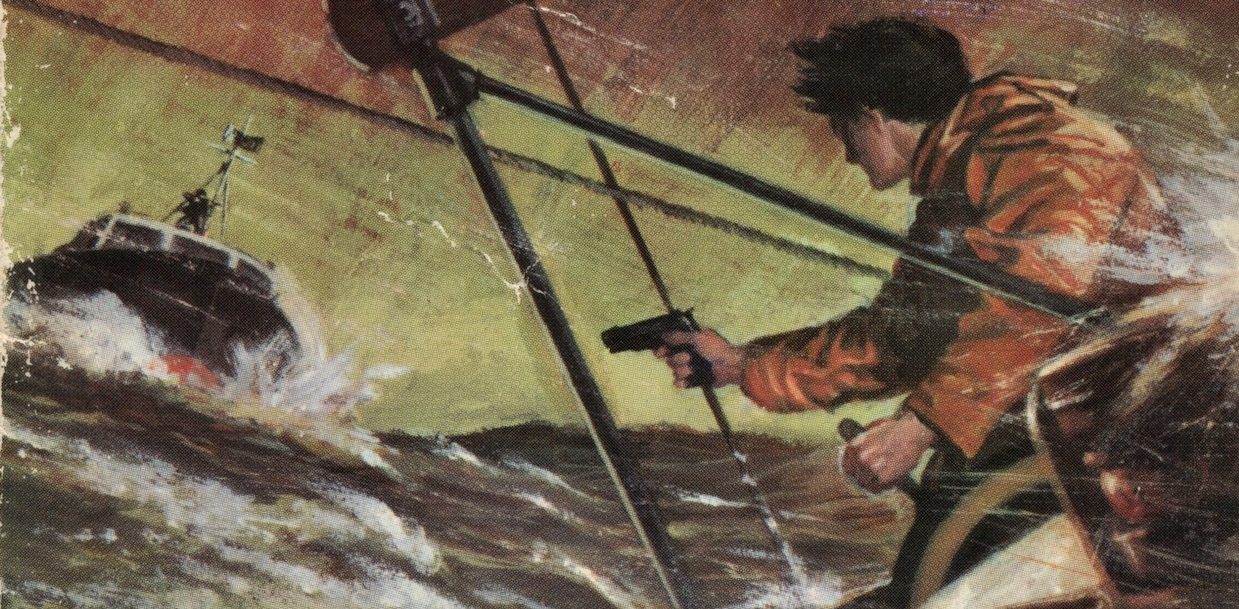

Since its publication on 28 September 1970, several occasions have seen options agreed for film and television rights to Running Blind. All of these ultimately failed until BBC Scotland acquired the rights in 1977 and produced, in Bagley’s own words, ‘an excellent’ three-part television adaptation dramatised by Jack Gerson. However, Hollywood and subsequent film producers had shown interest earlier.

Hollywood first took an interest in Running Blind shortly after publication, when film producer Aaron Rosenburg asked Bagley to visit Los Angeles to write a screenplay for a film adaptation.
Although Bagley went to Los Angeles in November 1970, the project ultimately failed. The author described the visit, an utterly frustrating experience, in an article in the Icelandic publication Tíminn two years later, in April 1973, and more can be read about this failed Hollywood production in the Running Blind archive. There is no trace of Bagley’s Hollywood screenplay for Running Blind in his collection at the Howard Gotlieb Archival Research Center, Boston University, and of it, in 1971, Bagley wrote:
It was the first script I’ve written and I don’t go a bundle on it – best to keep it hidden, in my opinion.1
In an interview with Dennis Barker from The Guardian, published on 23 February 1972, Bagley reflected on the subject of film options for his novels:
A very cool thinker, Mr Bagley – he can even say nuts to film producers who want him to write scripts. He has worked on a script in Hollywood, but the film was never produced. Film rights of two of his novels have been sold, and options on another two have produced cash.
‘But no films have been made yet out of any of them. I am interested in films, but I will no longer jump through hoops for producers – they are all talk and no action.’ 2
The situation did improve somewhat the following year when, on 31 January 1973, Geoff Reeve Productions Ltd., in association with The Rank Organisation, took up an exclusive twelve-month option for film and allied rights on Running Blind, to commence on 1 March that year (renewable for a further six months). At the time, Geoffrey J. Reeve was also producing an adaptation of Alistair MacLean’s novel Caravan to Vaccarès, published in 1970, in association with The Rank Organisation. Richard Morris-Adams, joint producer with Reeve on Caravan to Vaccarès, dealt with the options agreement, corresponding with Francis Bennett at Collins Publishers. Running Blind and Caravan to Vaccarès not only shared the same publisher, Collins, but also the same cover artist, Norman Weaver.

Born in Tring, Hertfordshire, Reeve won a county council scholarship to Berkhampsted School, where he excelled in sports, academics, school plays, and was a notable chorister. He served with the 7th Royal Tank Regiment in Hong Kong, and in 1953 he went to Exeter College, Oxford, to read law. He had a gift for singing and comic acting, finding an outlet for those talents in Oxford’s drama and revue companies.
In 1956, Reeve married Gina Gurney, and the couple moved to Canada, where he found an outlet for his creative talents by working for ICI and making promotional films for the company. Returning to the UK, Reeve made television commercials and joined Open Road Films, (the company of the talented writer, producer, and director Carl Foreman) as an associate producer. Foreman, an American, had been one of the screenwriters who had been blacklisted in the 1950s due to their suspected communist sympathy, and had relocated to the UK. While Reeve was investigating the film rights to several Daphne du Maurier books, he met thriller writer Alistair MacLean. MacLean had purchased Jamaica Inn, the coaching house on the borders of Bodmin Moor that Du Maurier immortalised in her 1936 novel. In 1967, MacLean formed a partnership with Geoffrey Reeve and Lewis Jenkins to make films for MacLean to write and Reeve to direct.
Reeve made his directorial debut with the 1971 film adaptation of MacLean’s Puppet on a Chain, for which MacLean wrote the screenplay. MacLean’s novel Caravan to Vaccarès was a similar collaboration for the pair, though Paul Wheeler wrote the screenplay. Reeve had clearly decided that Bagley’s Running Blind was also worthy of production.

© & courtesy The Guardian.
On 21 February 1973 Bagley received a letter of gratitude from Reeve:
I thoroughly enjoyed meeting you both with Ian the other day. Your help in giving me some more of the background to the story and to Iceland itself has been most welcome and I look forward to making a visit there with you in June. It is a pity we haven’t our Panavision cameras there now to record the latest eruptions.
In the meantime, we shall contact the Icelandic Tourist Board/Embassy to explain our plans to them.3
The ‘Ian’ referred to was likely Ian Graham Rodger, whom Reeve would commission to write the screenplay. The eruption mentioned likely referred to the Eldfell (Hill of Fire) eruption on the Icelandic island of Heimaey in the Westman Islands, which began without warning on 23 January 1973. This significant eruption temporarily evacuated the island and destroyed around 400 homes.
The June trip to Iceland was further confirmed on 6 March when it was reported in the Icelandic press that Bagley had recently written to his publisher in Iceland, Torfi Ólafsson, to inform him that Running Blind would be filmed in Iceland in the summer of 1974. It also reported that Bagley would be arriving in Iceland on 11 June 1973 with his wife, film producer Geoffrey Reeve, and two technicians. They would stay for a week to find suitable locations, and intended to spend three days in Reykjavík and three days in Akureyri. The cost of the project was estimated at 360 million Icelandic krona (approx £1.8m).4 Filming would also take place in the same locations as in the novel, including Kleifarvatn and Ásbyrgi.5

Ian Graham Rodger, commissioned by Reeve to write the screenplay, was a multi-talented journalist, author, translator, playwright and critic. Rodger, a former pupil of Westminster School, had spent 1944-47 with the Royal Air Force Volunteer Reserve and the Intelligence Corps, before attending the University of Durham, gaining an honours degree in English in 1952. He worked as a reporter at the Newcastle Journal (1952-4), and the Scottish Daily Mail (1954-5), then spent a year living in Sweden as a freelance journalist. As drama critic for The Listener (1958-61), he published his first novel set in Sweden: The Sun is Dead (Hutchinson, 1959). Nine Flowers – A Novel in Summer (Hutchinson, 1961) and Seven Beds to Christmas (Hutchinson, 1967) followed. In 1960 Roger married Mary Dorothy Ann Russell, who later said of her husband:
He was a writer who knew only how to write – nothing else. We were poor but didn’t know it. Ian’s writing career progressed. He wrote a number of stage plays – Cromwell at Drogheda was one – as well as a vast number of radio plays for the BBC. The Elizabeth R series of TV plays [televised in 1971] concluded with his ‘Sweet England’s Pride’ in which Glenda Jackson, now an admirable Member of Parliament, played the dying Queen Elizabeth. Occasionally Ian managed to have something of a regular income from his work as radio critic for The Listener and later The Guardian.6
Rodger’s autobiographical A Hitch in Time (Hutchinson, 1966) was described as an attempt at recapturing the impact of Europe on a person brought up in the wartime isolation of Britain; the blurb reads:
In 1965 Ian Rodger revisited France in a car with his family and hired a flat. He had not been in France for fourteen years. Driving south he recalled his earlier journeys, when he had hitch-hiked in search of the legendary Europe he had heard about during the war. He feels that in Britain the true nature of Europe is not understood and that hitch-hikers came nearer to understanding than most tourists. He speaks Swedish and French, and a little Dutch, Italian and Norwegian. He still hitch-hikes occasionally and always gives lifts. He was born in 1926.
When he was approached to write the Running Blind screenplay, Rodger had just finished writing a television documentary on Roald Amundsen, which he hoped the Icelandic filmmaker Gísli Gestsson would film. Though he was an experienced playwright for radio and television productions, Running Blind was to be Rodger’s first film screenplay, and he visited Iceland for a week-long research trip before beginning to write. Rodger sought assistance from Gísli, who accompanied him on the research trip.7
On 11 March Bagley had returned from a two-week visit to South Africa with Joan, and sometime after his return had suffered a serious attack of angina, being admitted to the intensive ward at Torbay Hospital, in Torquay. Writing to Kendall Duesbury at Collins on 30 April, he said he was now ‘at home and unable to travel up to London for some time’.8
By Friday 18 May Bagley’s health had improved considerably, and both he and Joan attended the 1st Crime Writers Association Conference at the Old Swan Hotel in Harrogate, Yorkshire. The Bagleys invited their Swedish friends, Iwan and Margareta (Inga) Hedman-Morelius, to the conference and hosted them during a full three-day journey back to their home at Hay Hill in Totnes.9 En route, they visited The Army and Navy Air Fleet Museum at Duxford, Cambridgeshire; the White Horse at Uffington, Oxfordshire; The Rifles Berkshire and Wiltshire Museum in Salisbury; and the Neolithic henge monument at Avebury. Iwan and Inga stayed with the Bagleys for a number of days and Iwan later recalled a Running Blind anecdote from this visit:
In his thriller Running Blind (Blindgångare, also filmed), which is set on Iceland, the hero Slade [sic, Stewart], had to escape from a very difficult situation and Simon had an idea to use a Ronson gas lighter. So, Joan, Simon’s ‘secretary’ and researcher, phoned Ronson in London and explained Simon’s idea.
“My God, you have not done it yet?” Was the terrified answer in the telephone.
Joan explained that so far it was only an idea and the man at Ronson suggested a meeting a few days later in London. When the Bagley’s arrived Ronson had planned a demonstration, which really made a great impression on the Bagleys. A fire was ready in an open stove and when everyone had taken cover, an almost empty gas lighter of plastic was thrown into the fire. Ten seconds later there was an explosion like one from a hand grenade. Simon was right in his thoughts and this was later used in his book (and the movie) as planned.10
At this point, Reeve & Morris-Adams’ production seemed well on track: Ian Rodger had written to Bagley, and a visit was arranged for him and his wife to be hosted at the Bagleys’ home. In the letter Rodger writes:
One further good omen. Geoff told me last night that when he travelled by plane from the South of France where he has begun shooting Caravan to Vaccarès, a smart French lady sat near him, reading – guess what? – Yes, Running Blind ! I do hope you will soon feel better.11
The pre-production trip to Iceland, scheduled for 11 June, never took place. The Icelandic press cited Bagley’s heart problems as the reason and said producer Geoffrey Reeve and writer Ian Rodger would now arrive in July.12
On 14 June, Richard Morris-Adams of Geoff Reeve Productions Ltd., based at 17 Thame Park Road, Thame, Oxfordshire, wrote to Bagley on Running Blind production notepaper.

I hope you like our writing paper! The map may not be accurate, but to the uninitiated, we believe it gives them an idea that the film at least is set in Iceland! I hope you approve.
Geoffrey is away for a while, and we are getting increasingly busy on our Caravan to Vaccarès project. As soon as he gets back towards the end of the month, I will speak with him and ask him to get in touch with you direct.
Thank you so much for your hospitality to Ian Rodger. He was pleased to have met you, and is busy working on the screenplay. I am pleased that you are recovering fast from your illness.13
Reeve did write to Bagley on his return, telling him he was pleased with Rodger’s first draft; however, because of the pressing timetable for Caravan to Vaccarès, he would be unable to go to Iceland this summer, but would get on with casting and planned to start shooting next June. Although there had been indications that this was when Bagley expected the shooting to start, it was perhaps the first inkling that Reeve and Morris-Adams’ production of Caravan to Vaccarès was directly affecting the Running Blind production timeline.14
If Bagley needed any fortification, it arrived unexpectedly in September, in liquid form, from Carlsberg Breweries. The author had received a letter from Jørgen Øst Larsen, Export Director of Carlsberg Breweries in Copenhagen, Denmark. Larsen wrote:
In Carlsberg’s export Department excitement is an everyday experience. However, some of us seem to have an insatiable appetite for thrills, and we think you ought to know that through your novels you continue to help satisfy this appetite.
One of our colleagues, a devoted reader of mysteries, even noted a complimentary reference to the Carlsberg Breweries on page 38 of your book Running Blind published by Fontana Paperback.
We much appreciate your view of our products and would like to send you an up-to-date sample within the next week or two.15
The complimentary reference mentioned in the novel reads:
‘What about some beer?’ asked Elin.
I grimaced. The Icelandic brew is a prohibition beer, tasteless stuff bearing the same relationship to alcohol as candyfloss bears to sugar. Elin laughed. ‘It’s all right; Bjarni brought back a case of Carlsberg on his last flight from Greenland.’
That was better; the Danes really know about beer.
Bagley’s response on 1 October shows his characteristic sense of humour:
What a nice gesture to a thirsty Englishman! As I sit here, drinking a bottle of your most welcome present, I reflect that it is the first time in a long writing career that a commercial firm has done such a thing. As you may know from the reading of my books my heroes tend to spend their time in charging madly over the landscape in Land-Rovers. As yet, though, British Leyland have not yet seen fit to give me a free sample. Let us hope that Lord Stokes follows your example.
On looking back over my reading one realises that the personal tastes of fictitious characters may be a powerful sales factor. Peter Cheyney’s Mr Callaghan, for instance, invariably drank Bacardi rum, while the commercial name dropping of James Bond was notorious.
I know of one other author, here in England, who tried to capitalise on this. The intention was to rent out pages of his novels to commercial firms for a fee – so many mentions of the product for such a price. I don’t think anything came of this, principally because the novels weren’t much good anyway.
You might like to know that Running Blind is being filmed in Iceland next year. As Technical Advisor to the film company I shall certainly see to it that bottles of Carlsberg appear in the relevant scenes. And Ray Pointon, the Sales Director of Fontana, will be delighted to know that his product is selling to such effect in Denmark.
Once again, thanks for your gift and unsolicited testimonial, both of which are appreciated by me and my wife.16
1973 ended without any further developments, though on 15 April 1974 Geoff Reeve Productions Ltd. renewed their film and associated rights option on Running Blind. Six months later, in October, the production seemed to have stagnated somewhat. Ian Rodger, writing to Bagley, commented:
It seems that Running Blind has begun to stagnate as far as the film is concerned. In May there was a frenzy of interest which now seems to have subsided altogether. My instinct tells me they have gone cold on it.17
What couldn’t have helped was the time devoted to the Caravan to Vaccarès production, which premiered in the UK on 8 August 1974.
Rodger, still clearly seeking information and seemingly not in contact with anyone at Geoff Reeve Productions, wrote to Bagley the following year on 18 March 1975:
Do Reeve Productions still hold the film rights on Running Blind or have their let their options lapse? I’m wondering whether it is worth scouting around to find other potentially interested parties. Can you let me know how things stand at present?18
Bagley’s reply confirmed Rodger’s assumption, and perhaps the author’s frustration with negotiating film options for his novels. He directed Rodger to make any further enquiries with Collins Publishers.
Yes, Reeve Productions have let the option lapse on Running Blind. I know it’s a pity about your script but that’s the way the movie business operates, or rather, doesn’t operate. I, also, wasted nearly three months of my time in Hollywood writing a script for the same book.
There is really no point in coming directly to me because I would push it on to them, anyway. They have all the legal and contractual know-how that I lack.
It was the Icelandic filmmaker Gísli Gestsson who gave clarity to the situation in an interview in May 1975, some two years after the research trip on which he accompanied Ian Rodger. In it, he said he had spoken with representatives from the film company, which had decided that filming Running Blind would no longer take place. He explained that the same film company had produced the movie of Alistair MacLean’s novel Caravan to Vaccarès, which turned out to be more costly than expected. Because Running Blind was expected to be more expensive, they simply did not have the finances to produce it. Gísli also offered two other reasons why the film company had been reluctant to produce the film in Iceland. First, they were appalled by the lack of facilities, particularly that they would have to bring all their equipment with them, as they could not hire any in Iceland. Second, inflation rates were a major obstacle for foreign companies wishing to work in Iceland.19
One wonders what Geoffrey Reeve and Richard Morris-Adams’ production of Running Blind would have been like, backed by The Rank Organisation, with the multi-talented Ian Rodger as scriptwriter and Bagley himself as Technical Advisor. Reeve and Morris-Adams’ production of Caravan to Vaccarès ultimately tolled the death knell for Running Blind. It is reported that Alistair MacLean did not attend the premiere of Caravan to Vaccarès, the screenplay, and that the plot of his novel had been virtually reinvented, not (in most people’s opinion) for the better.
Geoffrey Reeve began a long collaboration with actor Michael Caine in 1987 and died on 3 January 2010, at 77. His obituary in The Guardian notes his contribution to ‘polished mainstream British cinema in various forms over several decades. A generous man, a party-giver, who regarded cast and crews as members of his extended family. Actors including Caine, Gielgud, Sharif, Robert Hardy and Nigel Havers worked with him on several occasions’.
As for Ian Rodger, he continued his successful career in television and radio, and in 1981 he published his book Radio Drama, which deals with the development of radio drama from the 1920s to the early 1960s. On 30 August 1984 Rodger died of motor neurone disease. His screenplay for Running Blind has not yet surfaced, perhaps destroyed, or filed in another archive yet to be discovered; there is no trace of it in Bagley’s papers in his collection at the Howard Gotlieb Archival Research Center, Boston University.
Read contemporary Icelandic press articles about this failed production of Running Blind
References
- Images © HarperCollins Publishers Ltd (Running Blind & Caravan to Vaccarès), © The Guardian (Geoffrey Reeve & Michael Caine), © Murray Sayle (Ian Rodger), © Geoff Reeve Productions Ltd. (Notepaper – courtesy of The Desmond Bagley Collection, Howard Gotlieb Archival Research Center, Boston University), © Rank Group/Carlton Communications (Caravan to Vaccarès poster).
- Bagley, Desmond. Personal correspondence to Francis Bennet, Francis, Collins Publishers, London 18 July 1971. The Desmond Bagley Collection, Howard Gotlieb Archival Research Center, Boston University. Unpublished. ↩︎
- Michener, James. ‘Fortunes in men’s eyes.’ The Guardian, 23 Feb. 1972, p. 10. ↩︎
- Reeve, Geoffrey. Personal correspondence to Desmond Bagley, 21 Feb. 1973. The Desmond Bagley Collection, Howard Gotlieb Archival Research Center, Boston University. Unpublished. ↩︎
- ‘Metsölubók Bagleys kvikmynduð hér.’ Morgunblaðið, 6 Mar. 1973, pp. 31, 32. ↩︎
- ‘Desmond Bagley Hingað.’ Vísir, 27 Mar. 1973, pp. 1,16. ↩︎
- ‘Russell, Mary. ‘Biography’. http://www.maryrussell.info/biography.htm. Accessed 13 Jan. 2026. ↩︎
- Rodger’s research trip had definitely taken place before 8 May 1973, as it was reported in the Icelandic press: ‘Verður gerð sjónvarpsmynd eftir Njálssögu?’ Morgunblaðið, 8 May 1973, p. 12. ↩︎
- Bagley, Desmond. Personal correspondence to Kendall Deusbury, Collins Publishers, London. 30 Apr. 1973. The Desmond Bagley Collection, Howard Gotlieb Archival Research Center, Boston University. Unpublished. ↩︎
- The visit was reciprocal, as the Bagleys had visited Iwan and Inga in Sweden in May/June of the previous year. ↩︎
- Hedman-Morelius, Iwan and Margareta. Meeting with Authors and other people in the Book World, DAST Dossier No.10, 1997. ↩︎
- Rodger, Ian. Personal correspondence to Desmond Bagley. Undated. The Desmond Bagley Collection, Howard Gotlieb Archival Research Center, Boston University. Unpublished. ↩︎
- ‘Kaupa sumarbústað við Þingvallavatn til að kveikja í honum.’ Vísir, 16 June 1973, p. 20. ↩︎
- Morris-Adams, Richard. Geoff Reeve Productions Ltd. Personal correspondence to Desmond Bagley. 14 June 1973. The Desmond Bagley Collection, Howard Gotlieb Archival Research Center, Boston University. Unpublished. ↩︎
- Reeves, Geoffrey. Personal correspondence to Desmond Bagley. 6 July 1973. The Desmond Bagley Collection, Howard Gotlieb Archival Research Center, Boston University. Unpublished. ↩︎
- Larsen, Jørgen Øst. Carlsberg Breweries. Personal correspondence to Desmond Bagley. 10 Sep. 1973. The Desmond Bagley Collection, Howard Gotlieb Archival Research Center, Boston University. Unpublished. ↩︎
- Bagley, Desmond. Personal correspondence to Jørgen Øst Larsen, Carlsberg Breweries. 1 Oct. 1973. The Desmond Bagley Collection, Howard Gotlieb Archival Research Center, Boston University. Unpublished. ↩︎
- Rodger, Ian. Personal correspondence to Desmond Bagley. 17 Oct. 1974. The Desmond Bagley Collection, Howard Gotlieb Archival Research Center, Boston University. Unpublished. ↩︎
- Rodger, Ian. Personal correspondence to Desmond Bagley. 18 Mar. 1975. The Desmond Bagley Collection, Howard Gotlieb Archival Research Center, Boston University. Unpublished. ↩︎
- ‘Charlotte Rampling í “Caravan to Vaccarès”, en þessi mynd varð til þess, að ekkert verður úr fyrirhugaðri kvikmyndun á “Running Blind” hér á landi í sumar.’ Morgunblaðið, 11 May 1975, p. 46. ↩︎